What a System Replacement Really Costs Around Houston, and What Moves the Number
The honest answer is a range, not a number, because two houses with the same size unit can have very different jobs behind the wall.
August 27, 2026 · 4 min read
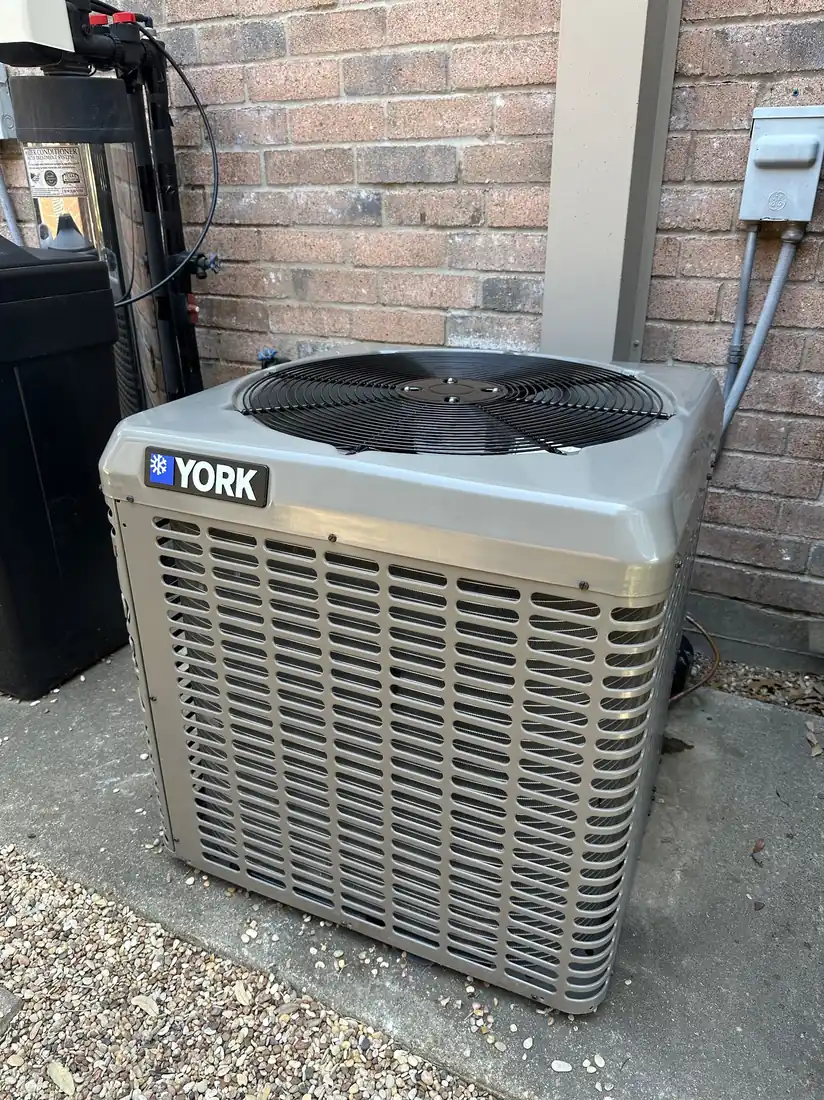
When an AC finally gives out for good, most homeowners have never priced a replacement before and the first few numbers they hear online can be wildly inconsistent. Some of that is genuinely regional. What a system costs installed in Houston-area heat and humidity, with the ductwork and code requirements common to homes here, isn't the same as a national average pulled from a site with no idea what state you live in. So rather than make you guess, or make you ask, we publish the Houston-area market guideline ranges we work from. These are averages for the area, not a quote for your specific home, but they're a real starting point.
Rough ranges by system size
System size is driven by square footage, so it's the first thing that sets the range. As a benchmark, fair pricing in this market runs about $2,800 to $3,800 installed per ton of cooling capacity. Below roughly $2,500 a ton, it's worth asking hard questions about what's being left out. Above $4,000 to $5,000 a ton, you're paying for something beyond the equipment itself, which isn't automatically wrong, but you should know what it is.
- 3-ton system, roughly a 1,500 to 2,000 square foot home: about $7,500 to $9,500 on the low end, $9,500 to $12,500 mid-range, $12,500 and up for high-end equipment and features.
- 4-ton system, roughly a 2,000 to 2,800 square foot home: about $9,000 to $11,000 low end, $11,000 to $13,500 mid-range, $13,500 and up high end.
- 5-ton system, roughly 2,800 to 4,000-plus square feet: about $10,500 to $13,000 low end, $13,000 to $16,000 mid-range, $16,000 and up high end.
What actually moves the price
The equipment itself is only part of the job. Every one of these adds real cost, and none of them are optional extras a contractor is trying to upsell you on, they're part of doing the install correctly.
- The newer R-454B refrigerant standard. Systems have moved to this refrigerant industry-wide, and depending on the age of what's being replaced, that can mean new line sets and equipment matched to the new standard rather than a straight swap.
- Plenum replacement, when the sheet metal box connecting the air handler to the ductwork has deteriorated or doesn't match the new unit's dimensions.
- Drain line updates, particularly on older homes where the condensate line was never brought up to current practice.
- Electrical updates, if the disconnect, wiring, or breaker doesn't match what the new equipment needs.
- A new thermostat and controls, which newer high-efficiency equipment often requires to run correctly.
- Ductwork and refrigerant line replacement, when the existing runs are too small, too old, or leaking enough that reusing them would undercut the new system's performance.
Repair versus replace
Not every dying system needs to be replaced, and it's worth being honest about when a repair is the smarter call. A system under ten years old with a single failed part is usually a repair, plain and simple. Once a system is well past that age and starts stacking repairs, a compressor issue on top of a coil leak on top of a system that was already running on an outdated refrigerant, the math changes. Each repair is a real cost with no guarantee the next part won't fail a season later, while a new system comes with a warranty and years of predictable performance. We'll tell you plainly which side of that line your system is on rather than pushing a replacement a repair would genuinely fix.
Spreading the cost
A number in the thousands of dollars doesn't have to be paid all at once. We offer financing through Synchrony Financial, including same as cash plans, so a replacement doesn't have to wait for the full amount to be sitting in an account. As a rough monthly guide, a 3-ton system tends to run about $125 to $300 a month, a 4-ton about $138 to $330, and a 5-ton about $150 to $360, depending on the plan and the term. You can apply online and get a decision in minutes.
Getting a real number for your house
Guideline ranges are useful for planning, but the only way to know what your house actually needs is to have someone measure the square footage, look at the existing ductwork and electrical, and size the system correctly rather than just matching whatever is being pulled out. We're a York dealer, but we handle all makes and models, and Texas licence TACLA166258C means the electrical and refrigerant work is done to code, not guessed at. If your system is getting old and you want a real number instead of a guess, call (713) 303-4552.
Steadfast AC Service, (713) 303-4552
Call (713) 303-4552More articles
What Actually Breaks on a Texas AC in August, and What You Can Check First
The heat doesn't break your AC directly. It just runs the system long enough that whatever was already weak finally gives out.
Why Upstairs Is Hotter Than Downstairs in a Two-Story Tomball Home
Heat rises, but that's only part of why the top floor never seems to cool down like the rest of the house.