What Actually Breaks on a Texas AC in August, and What You Can Check First
The heat doesn't break your AC directly. It just runs the system long enough that whatever was already weak finally gives out.
August 27, 2026 · 3 min read
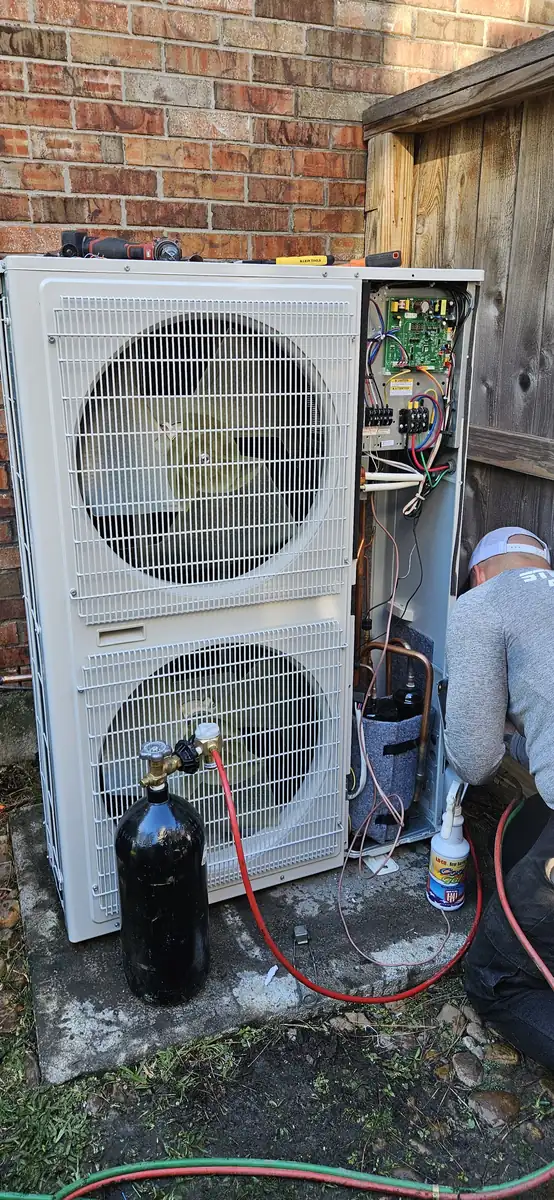
By the middle of August, most Tomball systems have been running close to around the clock for weeks. That's not unusual and it's not automatically a problem. But it does mean any part that was already marginal, a weak capacitor, a contactor with a little pitting on the contacts, a condensate line that was slowly narrowing, finally gets pushed past the point where it can keep up. That's why service calls cluster in July and August. It isn't bad luck. It's just load.
The part that fails most often
If we had to bet on one component before we even pull the panel, it would be the run capacitor on the outdoor unit. It's a small cylindrical part that gives the compressor and the fan motor the extra push they need to start and keep spinning. Capacitors age on a curve, not a switch. They lose capacitance slowly over years, and a Texas summer's heat speeds that up, because heat is hard on electronics generally. The system will often still run fine on a cool morning and then struggle or trip out entirely once the afternoon temperature climbs. If your outdoor unit hums but the fan doesn't spin, or it starts and stops repeatedly, a weak capacitor is a common cause.
The clog you can't see
The second most common August call around here isn't electrical at all. It's water. Every AC pulls moisture out of the air as it cools it, and that condensate has to drain somewhere, usually through a plastic line that runs from the indoor coil out to the yard or into a drain. In a humid Gulf Coast summer that line is working overtime, and algae and dirt build up inside it faster than people expect. When it clogs, most systems are built to shut themselves down rather than let water back up into the house, which is the right design. It just means a system that seems to have died completely might only need that line cleared.
Frozen coils, and why turning it off matters
If you notice ice on the indoor coil or on the refrigerant lines, the instinct is usually to keep the system running and hope it fixes itself. Do the opposite. Switch the thermostat to fan only, or off completely, and let it thaw fully before anyone runs it again. Running a frozen system can push liquid refrigerant back into the compressor, which is one of the more expensive ways to turn a simple fix into a much bigger one. Low airflow from a dirty filter is the single most common cause of a frozen coil, which is also the good news, because it's the easiest thing on this list for you to check yourself.
What you can check before you call
- Pull the filter and hold it up to a light. If you can't see light through it, replace it. A clogged filter starves the system of airflow and is behind a surprising share of no-cool calls.
- Check the outdoor breaker and the disconnect box next to the condenser. A tripped breaker or a pulled disconnect is sometimes the whole story.
- Look at the outdoor unit itself. Grass clippings, a fallen branch, or a fence panel set too close can choke airflow across the coil and make the system work far harder than it should.
- If you see ice anywhere on the lines or the indoor coil, switch the system off and let it thaw before calling. It makes the diagnosis faster once a technician is on site.
When it's time to call
None of the above is a substitute for a licensed technician, and Texas licence TACLA166258C means the checks that matter for safety and refrigerant handling are ours to do, not yours. But a quick filter check and a look at the breaker save a fair number of Tomball homeowners an unnecessary trip, and the ones that do need a visit go faster once we know what's already been ruled out. We work on all makes and models, not just the equipment we install, so it doesn't matter what brand is bolted to the side of your house. And because Texas summers don't wait for office hours, after-hours emergency service is genuinely available on top of our posted Monday through Friday schedule. If your system is struggling in the middle of an August afternoon, call (713) 303-4552.
Steadfast AC Service, (713) 303-4552
Call (713) 303-4552More articles
Why Upstairs Is Hotter Than Downstairs in a Two-Story Tomball Home
Heat rises, but that's only part of why the top floor never seems to cool down like the rest of the house.
What a System Replacement Really Costs Around Houston, and What Moves the Number
The honest answer is a range, not a number, because two houses with the same size unit can have very different jobs behind the wall.